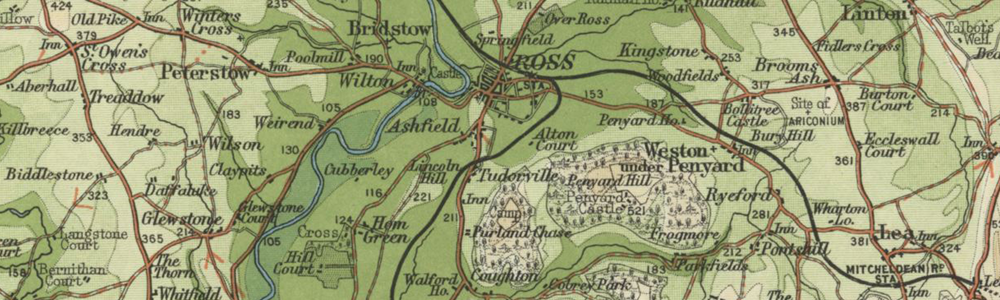
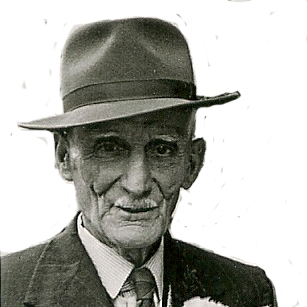
- BORN – 14th October 1880 in Stroud, Gloucestershire.
- MARRIED – 5th April 1906 to Lizzie Barnett at Ross Register Office, Herefordshire.
- DIED – 25 July 1965 in Ross-on-Wye, Herefordshire.
George Dorrington French, my Grandfather, was born on 14th October 1880 the youngest child of Alfred and Ann (nee Stockham) French. He was baptised at the Holy Trinity Church in Stroud on 5th June 1881.

In the 1881 Census (taken on 3rd April 1881) George is listed as living with his father, mother and brother Frank (age 9) at Upper Lypiatt Terrace in Stroud. His brother John (aged 14) is living a few doors away, a visitor at the house of George Cole. John’s occupation is shown as a “Woolen Cloth Presser”. George’s eldest brother, Alfred John Joseph French who was born in 1865, unfortunately passed away when he was less than a year old. In 1885 his mother Ann died aged 40 years old, she was buried on April 4th in Holy Trinity Church, Stroud. I’m not sure what effect the death of his wife had on Alfred but the next time we come across him and his son George is on the 1891 Census. At this time they are both residents of the Stroud Union Workhouse with father and son both designated as “Pauper Inmate”. His brother Frank, aged 19 and sister Annie, age 15 working as tailor and tailoress respectively are living as boarders in the house of James Mills on Lypiatt Terrace.
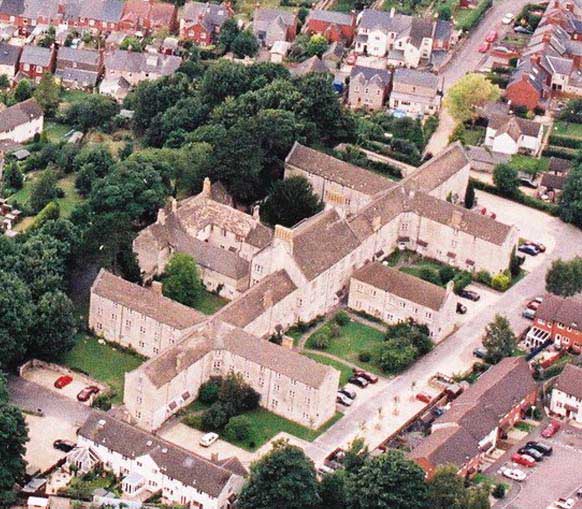
Workhouses were introduced after the Poor Law Amendment Act of 1834, when it was decreed that paupers should only have access to charity if they committed themselves to an institution. Stroud Union Workhouse was built in 1837 and was designed to house up to 500 inmates. Just like a prison the workhouse robbed its residents of their freedom and identity with children separated from their parents and husbands from their wives. Laurie Lee in his novel “Cider With Rosie” described Stroud Workhouse as “…always a place of shame, grey shadows falling on the close of life, most feared by the old; ….abhorred more than debt or prison or beggary even the strain of madness.” In the 1840’s a particularly shocking incident occurred in this workhouse when a mentally disturbed boy died after being made to bathe in a bath of boiling water (those washing him had forgotten to turn off the steam!!). The boy’s screaming was ignored as according to the master it was normal for him to behave this way. What scars being in the workhouse left on the young George we will never know but ten years later in 1901 he was fit and able enough to join the militia.
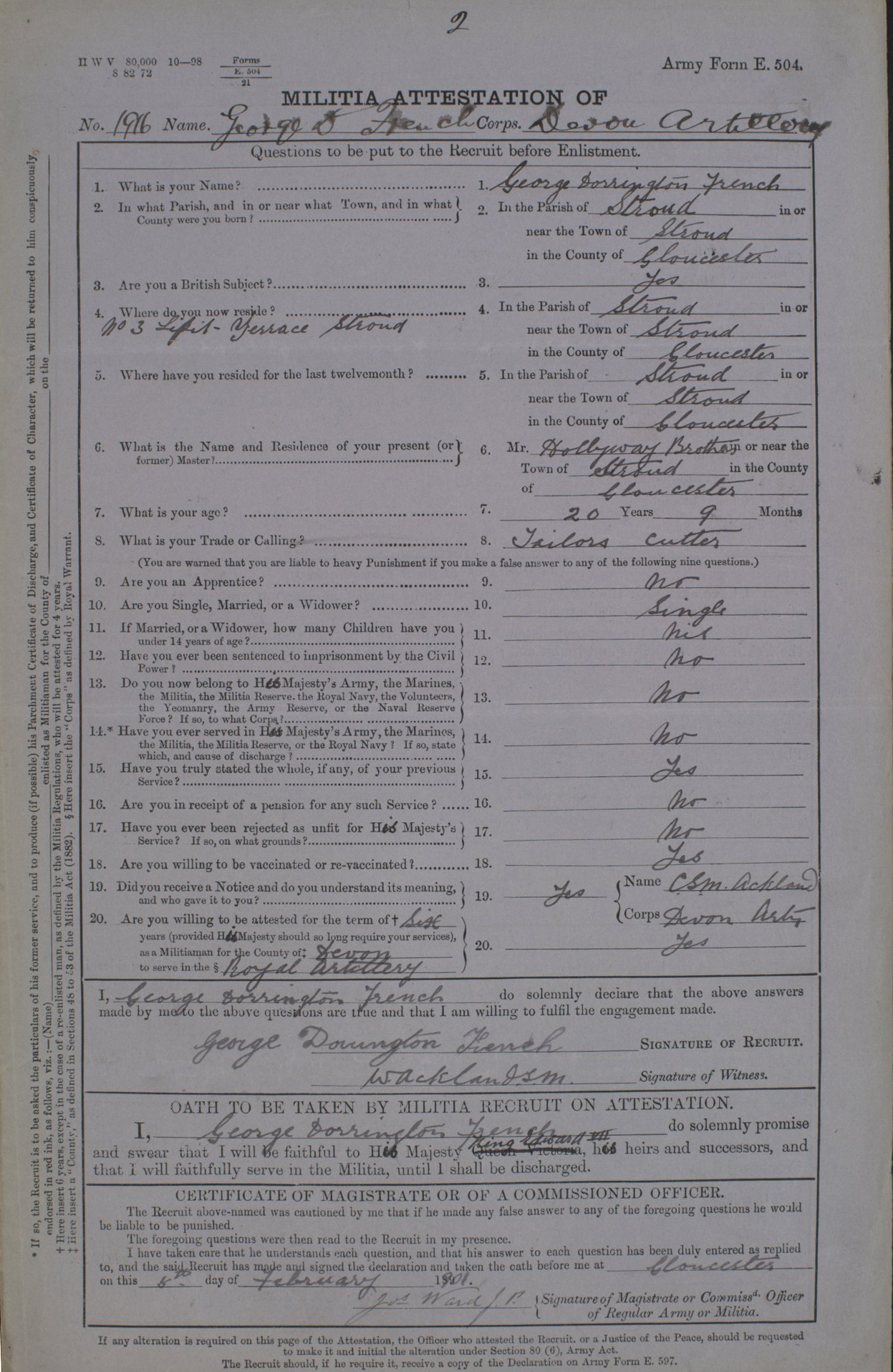
The county militia were the military reserve forces and generally comprised of volunteers from the county. The North Devon Militia was converted into an artillery unit in 1853 (The Devon Artillery Militia) with a role manning the forts that protected the naval base at Plymouth. As an artillery unit it was open to men who resided outside the county.
The initial training on enlistment was 7-8 weeks then the recruit returned to civilian life but reported for a 2 week training camp every year. The pay they received was a useful top-up to their normal wages while the training camp was viewed as a paid holiday. These camps generally held in the summer months drew great local interest becoming very much part of the local social calendar. The troops would spend a day marching, drilling and firing their guns for the entertainment of the gathered crowds.
According to George’s attestation form he was living at 3, Lypiatt Terrace, in Stroud when he joined and was employed as a Tailor’s Cutter at Holloway Brothers in the town. [The Holloway brothers were one of the biggest employers in Stroud, with over 1500 workers making shirts and other clothing. They are said to have operated the first sewing machines powered by steam in the World]. The form also shows he was 5ft 8ins tall with a chest measurement of 33-35 ins, weight 124 lbs and having a sallow complexion with brown eyes and hair.
When the 1901 Census was recorded on 1st April 1901, George had finished his basic training and was living with his brother Frank at 84 Franklyn Street Bristol. His occupation at the time was stated as “Carter on farm (horse)”.
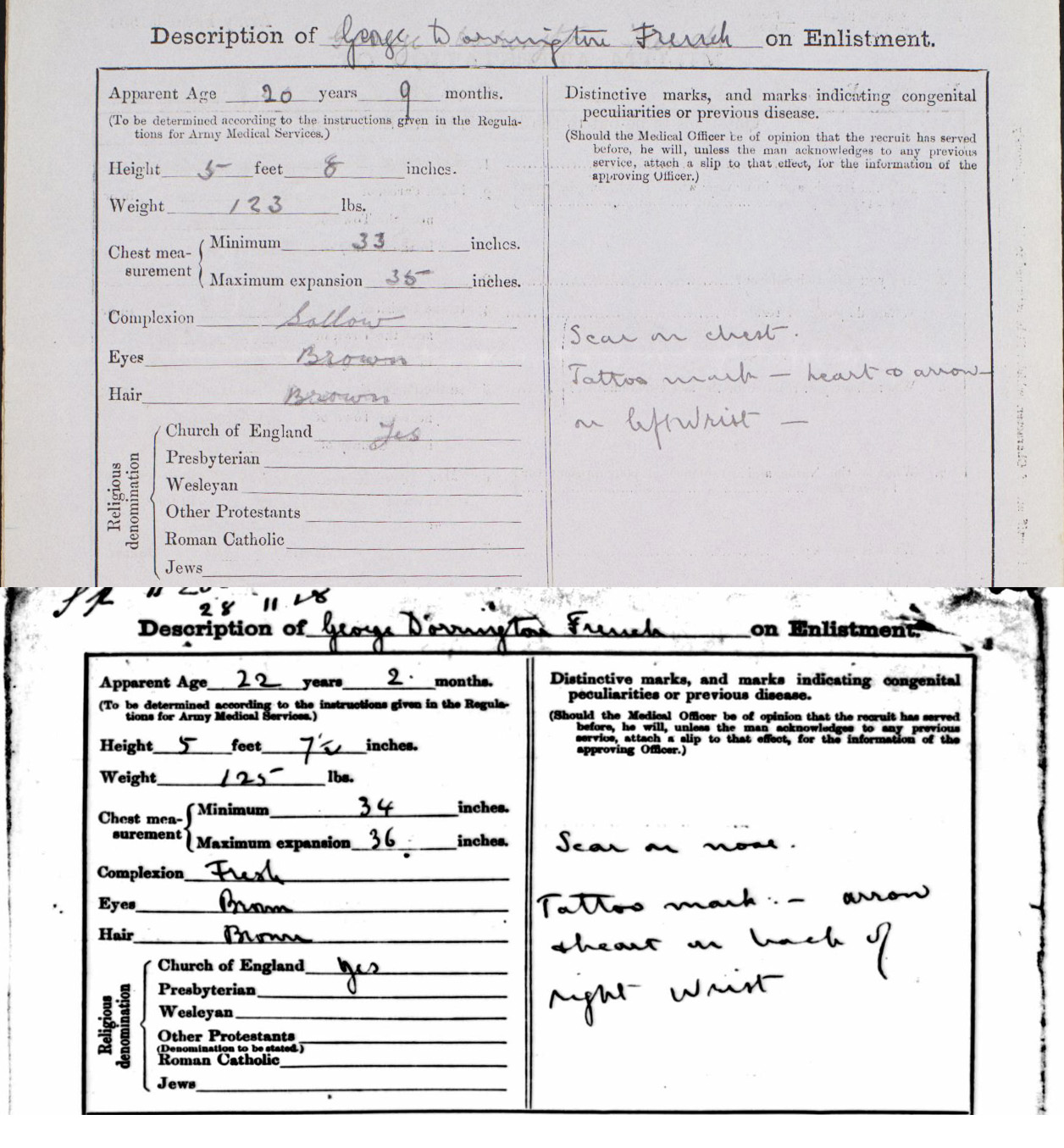
Whether the country air didn’t suit him or whether the lure of joining the army full-time was too much we will never know but in December 1902 George signed up for a “Short Service” with the Royal Garrison Artillery. Short service at this time meant 3 years with the colours (full time army) followed by 9 years in the reserve, the reserve being called back to full time duties if needed. Working on the farm for 20 months had obviously been good for George as his “Sallow” complexion had turned to “Fresh”, his weight had increased by a couple of pounds and his chest measurements had increased by an inch. More difficult to explain is the movement of his “arrow and heart” tattoo from his left wrist to his right.
After spending 3 months in Gosport he served in Gibraltar from March 1903 to September 1905, returning home to complete his service in December 1905. Throughout this time his next of kin was listed as Alfred French, his father, whose address was given as 3, Overross, Ross, Herefordshire. Therefore on discharge from his colours Grancher French ended up in Ross probably to stay with his father.
The next important event in his life took place just four months later, which was his marriage to my Granny, Lizzie Barnett. Whether George and Lizzie knew each other from his visits to Ross whilst on leave from the forces or whether it was just a whirlwind romance, I will never know but the couple tied the knot at Ross Register Office on 5th April 1906. On the marriage certificate Lizzie’s age is noted as 19 and George’s 24 whereas my calculations make them 16 and 26 respectively, also Lizzie’s father is shown as Thomas Henry Barnett where other records indicate her father’s name is either Thomas William or William Thomas. I can only speculate that these discrepancies indicate that the marriage was arranged hastily probably without Lizzie’s father’s permission.
The couple were joined on June 27th 1907 by the birth of their son George Dorrington Jnr, the address given on his baptism was 5 Kyrle Street in Ross, and his fathers occupation was listed as Labourer. Two years later the family grew again with the arrival of Hannah Elizabeth Anne (later to become my mother) on 20th October. The family having now moved to 9 Greytree Road Ross. On the 1911 Census which was taken on 2nd April George’s occupation is shown as labourer at the gas works. These were located at the top of the street and I can clearly remember the gas holders growing up in the town but having no knowledge of my grand father ever working here. The gas holders were demolished in June 1985.
On December 9th 1911 George and Lizzie’s second son Alfred Cecil was born, the family still living on Greytree Road. His short life lasted a mere 8 months as he passed away on 5th August the following year by which time the family had moved to 3 The Nursery, Ross.
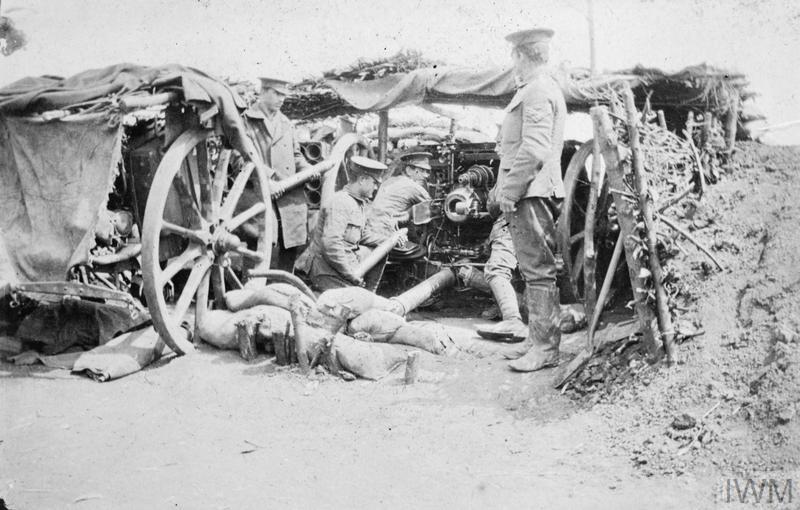
On 28 June 1914 the Archduke Franz Ferdinand, heir to Austria-Hungary’s throne, was assassinated by Serbian nationalist Gavrilo Princip. This lead to an escalation of tension in Europe and eventually on August 4th 1914 Britain declaring war on Germany and the other Central Powers. As George was still serving his ten years in the reserves he received his call up on August 5th 1914 and was immediately mobilised to Plymouth. He served in the RGA as part of the 1st Siege Battery which I believe were using heavy howitzers, these as the name suggests were very heavy guns usually transported by tractors. From his military records we know that he was stationed in France from 17th September as part of the British Expeditionary Force.